

PRESS RELEASE
IIT Kharagpur Researchers Develop Novel Urban Pollution–Heat Index for Sustainable Future Cities and Health Assessment
Kharagpur, 22nd May 2026: Researchers from the Indian Institute of Technology Kharagpur have developed a first-of-its-kind scientific framework integrating urban heat and air pollution exposure into a single health-risk metric to support sustainable urban planning and climate-resilient city development.
The study, titled “An Integrated Heat and Pollution Index for Sustainable Urban Planning: Evidence from Delhi”, has been led by Prof. Jayanarayanan Kuttippurath and VK Patel from the Centre for Ocean, River, Atmosphere and Land Science (CORAL), IIT Kharagpur. The research introduces the Urban Human Pollution Index (UHPI), a pioneering framework that jointly assesses the combined impacts of multiple air pollutants and Urban Heat Island (UHI) effects on human health and urban sustainability.
Published in Case Studies in Chemical and Environmental Engineering on 21 April 2026, the study addresses a critical gap in conventional urban assessments, where air pollution and urban heat have largely been evaluated independently despite their interconnected impacts on urban populations.
The researchers highlight that rapid urbanisation, increasing anthropogenic emissions, and warming climatic conditions are intensifying the interaction between heat and pollution in cities, creating compounded environmental stress and public health risks. The newly developed UHPI framework offers a comprehensive and scalable scientific tool to identify urban hotspots vulnerable to simultaneous pollution and heat exposure.
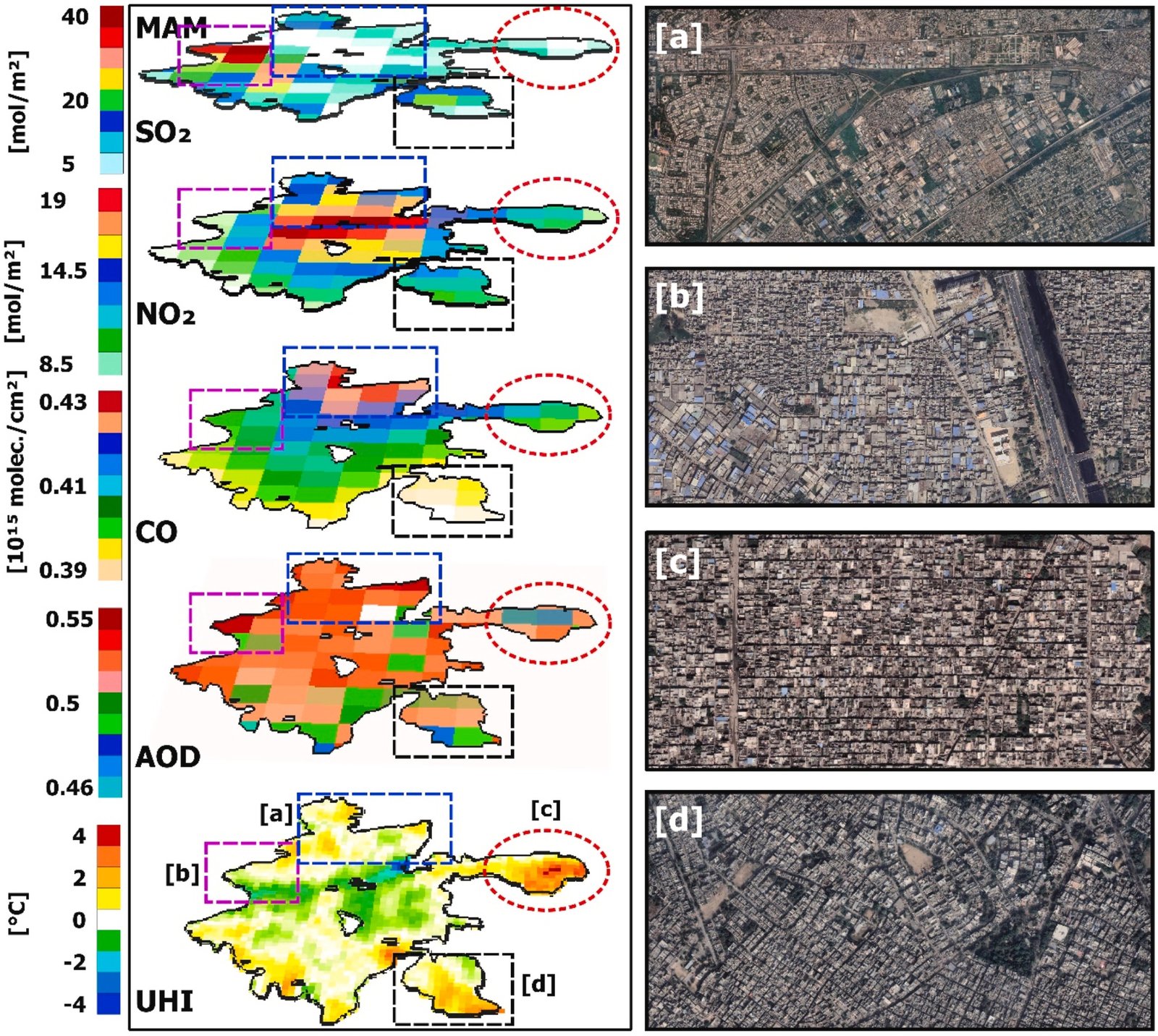
Using Delhi as a case study, the research reveals significant spatial disparities in pollution–heat stress across the city. Densely urbanised and industrial regions, particularly central, eastern, and parts of northwestern Delhi, exhibit elevated UHPI values, indicating greater environmental stress and higher public health vulnerability. In contrast, greener and less densely built peripheral regions demonstrate relatively lower UHPI values and may offer more sustainable pathways for future urban expansion.
The study further underscores the urgent need for integrated urban policy interventions such as expansion of green infrastructure, sustainable transportation systems, reduction of vehicular and industrial emissions, preservation of open spaces, enhancement of urban ventilation corridors, and adoption of climate-sensitive urban planning strategies. The researchers note that approaches focusing solely on either pollution or temperature may significantly underestimate cumulative urban exposure risks.
With growing global concerns over climate change, urban heat stress, and deteriorating air quality, the UHPI framework is expected to serve as an important decision-support tool for policymakers, public health authorities, urban planners, and environmental agencies worldwide. The framework is adaptable for cities across both developing and developed nations and has the potential to contribute significantly toward climate-resilient and sustainable urban futures.
Pratik Dama
Public Relations Officer
Indian Institute of Technology Kharagpur
Kharagpur – 721 302, Bharat
Mob – 9975654202 / pro@iitkgp.ac.in